
Completed field work at the Pioneer field
At the beginning of September 2025, at the Pioneer deposit, SMT specialists completed support for the program of geomechanical and hydrogeological study of the perimeter mining massif. Within the project, the total volume of geomechanical drilling amounted to 5,320 linear meters . The development of the field research program was also carried out by SMT.
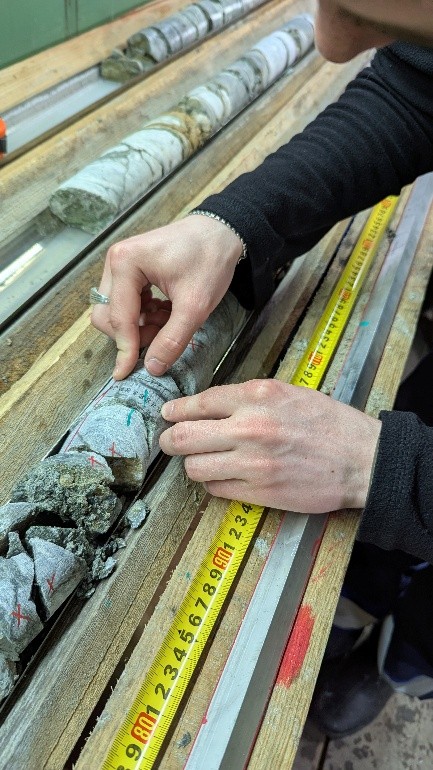
SMT performed geomechanical documentation of the oriented core. The work was carried out directly at the well in two shifts, which ensured efficiency and high accuracy of research.
During documentation, the following indicators were recorded: RQD; number of cracks; petrography; changes (weathering); intensity and strength of microdefects; macro-roughness; micro-roughness; aggregate mineralogy; aggregate strength; opening of cracks; crack wall strength; number of crack systems.
For each classified structure, the Alpha and Beta angles were recorded.
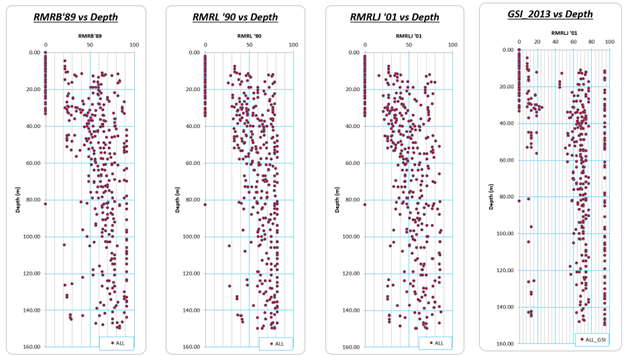
Based on the results of the collected information, SMT specialists calculated rating indicators. These data will become the basis for constructing a lithological-structural model and a block geomechanical model, and will also be used in calculating the stability of slopes and sides of the quarry.
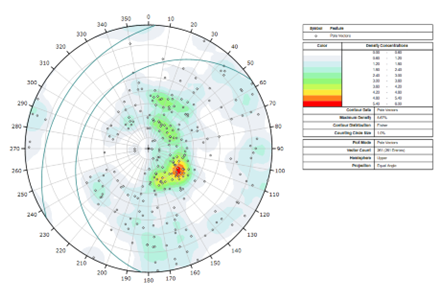
Based on the results of crack orientation measurements, a structural analysis was performed. The results obtained will become the basis for zoning the quarry field according to the stable parameters of benches and berms.
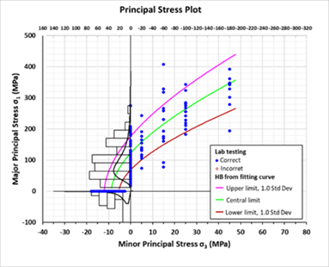
Also during the documentation process, samples were selected for various types of tests, such as:
• Determination of tensile strength, Young’s modulus, Poisson’s ratio under uniaxial compression (UCS YP) according to GOST 21153.2.-84
• Determination of uniaxial tensile strength (UTS-Brazilian method) according to GOST 21153.3–85
• Determination of ultimate strength in direct shear along a natural crack (SOJ) according to ASTM D5607-2 standard (three-stage shear), construction of a strength passport and calculation of adhesion and angle of internal friction
• Determination of tensile strength in direct shear cut (SCS) according to ASTM D5607-2 standard (three-stage shear), construction of a strength data sheet and calculation of adhesion and angle of internal friction
• Determination of the ultimate strength in triaxial compression (TCT) according to GOST 2153.8–88, construction of a strength passport and calculation of adhesion and angle of internal friction
• Determination of compressive shear strength (CCS) according to GOST 2153.5-88, construction of a strength certificate and calculation of adhesion and angle of internal friction
Subsequently, the test results are processed in specialized software in order to construct strength passports and involve the results obtained in various stability calculations.
During field hydrogeological studies at the field, a complex of experimental filtration works (OPF) was successfully completed. The studies were carried out in a number of wells using modern methods, including rapid tests, staged injections, experimental loading and single pumping.
To carry out the research, modern equipment was used, including IPI’s own SWIPS packer system for isolating intervals. Some wells were equipped with systems for continuous monitoring of groundwater levels and permafrost thickness.
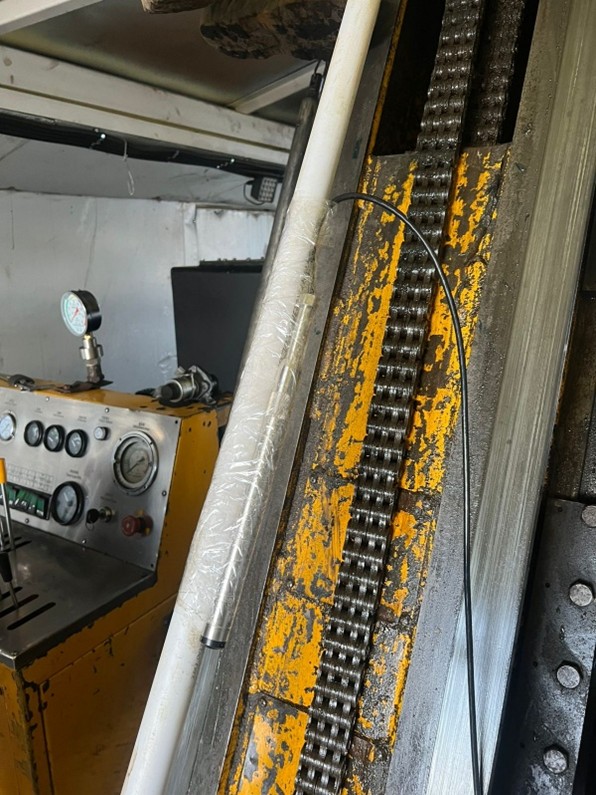
All work was completed on schedule during the field season.
The monitoring results made it possible to identify island permafrost zones. To clarify its spatial distribution and dynamics, regular monitoring of readings has been organized, which will be carried out until the temperature regime is completely stabilized.